
Away Days in Germany: How Visiting Supporters Travel
Away Days in Germany — How away days work in Germany: the away block, ticket allocations, rail travel with the match ticket and what to expect on arrival.
Quick facts
| Area | Bundesliga |
|---|---|
| Grounds covered | Stadion An der Alten Försterei (22,012) · Millerntor-Stadion (29,546) · Signal Iduna Park (81,365) |
| Getting there | All of the grounds below sit on city public transport; check the last service before kick-off. |
| Published | 2026-09-28 |
away days in germany are the cheapest and the loudest in western Europe, and that is not a romantic claim so much as an accounting one. A standing place at a Bundesliga ground costs less than a seat at almost any comparable club on the continent, the trains between cities run all evening, and the grounds are built so that the visiting support is close enough to the pitch to affect the game.
The scale is the other half of the story. A weekend can take you from a 22,012-capacity neighbourhood ground in Berlin to an 81,365-capacity bowl in Dortmund in the space of a day, and both are configured differently: Union Berlin keep 18,395 standing places against only 3,617 seats, while Dortmund fill a south terrace of 24,454, the largest standing area in European football.
How the away section germany hands visiting fans works
The away section germany allocates to visiting supporters is normally a corner or an end behind a goal, sold in blocks by the visiting club rather than by the host. That single arrangement shapes everything: you buy from your own club's ticket office, you travel with your own supporters, and you sit or stand in one defined pocket of the ground.
The blocks themselves are usually generous by British or Spanish standards. Terraces survive in the away areas at several clubs, and even where the visiting section is seated, it is rarely the worst view in the stadium. At Dortmund the visiting block sits high in the corner at the north end; at St Pauli it is a covered corner with a clear view down the pitch.
bundesliga away fans and the price of a weekend
bundesliga away fans benefit from a ticket structure that has kept the cheapest places cheap. Terracing is the reason: standing places are priced far below seats, they are usually unallocated, and they let a club sell the same amount of space to two or three times as many people.
That is why German away ends can be full on a Tuesday night. Add the fact that kick-off slots run from Friday evening to Sunday afternoon, and a two-match weekend becomes genuinely realistic: an away day in the Ruhr on Saturday and a second ground on Sunday, with a regional train between them.
Rail travel: the part that makes Germany work
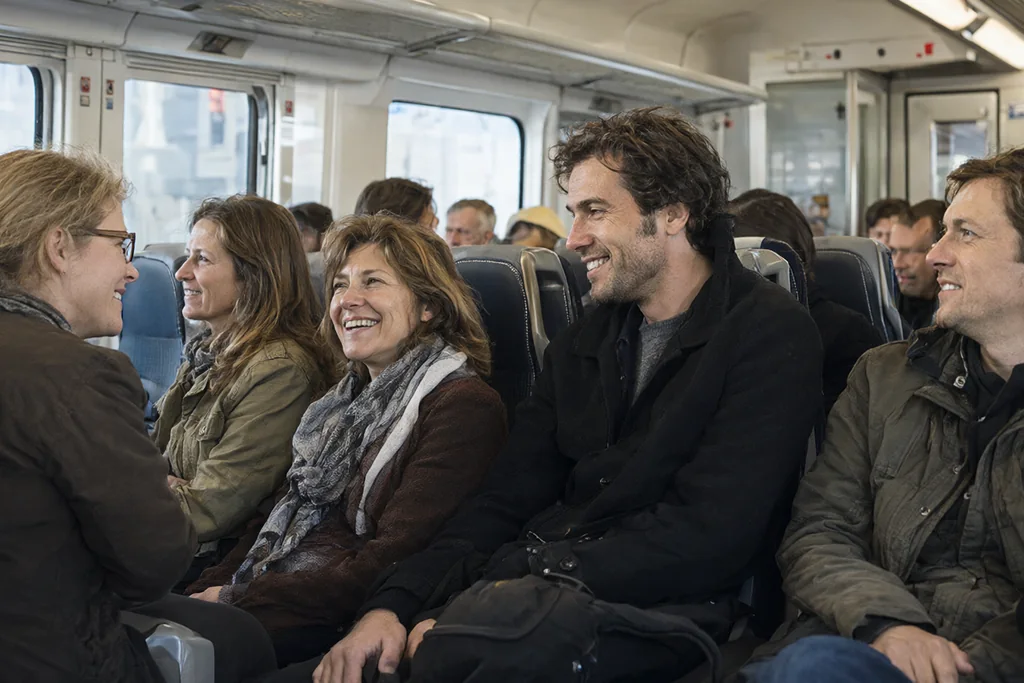
Rail travel is what turns these trips from a project into an evening out. German cities sit on a dense network of regional expresses and S-Bahn lines, and the big grounds are built around stations rather than motorway exits. At St Pauli the U-Bahn station is a few minutes from the turnstiles; at Dortmund the ground is a walk from the Westfalenhallen and the main-line stations.
Two rules are worth knowing. First, regional tickets are usually bought separately from the match ticket, so budget for both unless your host club says otherwise on its own ticketing pages. Second, evening kick-offs mean the last trains are tight but rarely impossible, and the crowd on the platform is part of the matchday rather than an obstacle.
Terraces, standing and what to expect inside
Standing is normal here, and it changes the way a crowd behaves. People arrive early to claim a rail, they stand in the same place for two hours, and the singing comes from the middle of the terrace rather than from a block of seats with a drum.
If you cannot stand, buy a seat, and be aware that seated blocks in the same stand are often separated from the terrace by a fence. Families and older supporters use the seated sides, and nobody treats the choice as a statement.

Matchday timings that actually work
The German matchday has more structure than most visitors expect, and knowing the order of events removes most of the stress. Concourses open well before kick-off, food and drink are cheap inside the ground, and clubs publish their own arrival advice for visiting supporters.
- Book the train after the fixture is confirmed, not before, because Bundesliga kick-off slots move for television.
- Travel to arrive two hours early; away blocks often have a single entrance and long queues.
- Keep your ticket with you at all times; it is checked again on the concourse at some grounds.
- Buy food inside rather than outside if the streets around the ground have no bars.
- Plan the last connection home before the match, not after the final whistle.
Which grounds to pick for a first away weekend
If you have one weekend, pick the ground whose character you want rather than the one with the biggest number. Size is not the same as atmosphere, and the German league is full of grounds where the smaller capacity wins.
| Ground | City | Capacity | What the away day gives you |
|---|---|---|---|
| Signal Iduna Park | Dortmund | 81,365 | The biggest crowd in the country and the south terrace opposite you. |
| Veltins-Arena | Gelsenkirchen | 62,271 | A modern bowl with a closed roof and a short regional train hop from Dortmund. |
| Millerntor-Stadion | Hamburg | 29,546 | Pre-match bars on the Reeperbahn and a ground inside the district. |
| Stadion An der Alten Försterei | Berlin | 22,012 | Standing terraces on three sides and a walk through Köpenick. |
| Vonovia Ruhrstadion | Bochum | 26,000 | A tight old ground where the away end is closer to the pitch than anywhere else. |
The away day in Germany is a habit rather than an event, and that is precisely why it works. Supporters treat a four-hour train as ordinary, tickets are sold to people who travel, and the grounds were designed on the assumption that the visiting crowd would be large, loud and standing. Book a Saturday, take a Sunday as well, and the country will fill both days.
Related guides

Away day Seville: Real Betis, Heliópolis and the walk back
Seville is one of the easiest big-league away days in Europe: an airport, a tram and a stadium fifteen minutes from the old town.
2026-09-28
Away day Rotterdam: De Kuip, the trams and the river
Rotterdam is a compact away day: the stadium sits south of the river, and a tram from the centre gets you there in twenty minutes.
2026-09-28
Two grounds in one weekend Ruhr: Saturday in Dortmund, Sunday in Bochum
A Ruhr weekend works because the grounds sit on the same S-Bahn and regional network, so two matches in two days need no car.
2026-09-28